
REGIONAL INDEX
REG-0005
TRANSMISSION DUNE SEA
AEOLIAN TRANSMISSION CORRIDOR
Long-range transmission pathways remain active as shifting dune formations continue to redirect the propagation of environmental signals across the surveyed region.
CLASSIFICATION
Persistent Transmission Corridor
TOPOLOGY
Signal-Embedded Dune Network
SIGNAL CONDITION
Persistent / Long-Range
OBSERVER CONDITION
Extended exposure may produce navigational drift and
persistent directional signal acquisition.
ARCHIVE STATUS
Transmission Network Verified
KNOWN STRUCTURAL STATE
Active beneath surface layers.
Long-range transmission persists between surveyed sectors.

ENVIRONMENTAL DESCRIPTION
Traversal through Transmission Dune Sea sectors does not guarantee stable signal orientation between active relay corridors.
Sub-surface transmission pathways remain intermittently detectable beneath dune formations despite long-term environmental burial.
Long-range signal propagation continues across inactive transmission infrastructure during low-atmospheric cycles.
Transmission Dune Sea presents as a vast relay-field environment containing dormant transmission architecture, buried convergence systems, and persistent directional signal activity.
Observers report synchronised light events, intermittent directional acquisition, and low-frequency resonance propagating between distant relay structures.
No confirmed transmission origin, terminal destination, or complete network topology has been recovered.
TOPOLOGY / SIGNAL CONDITIONS
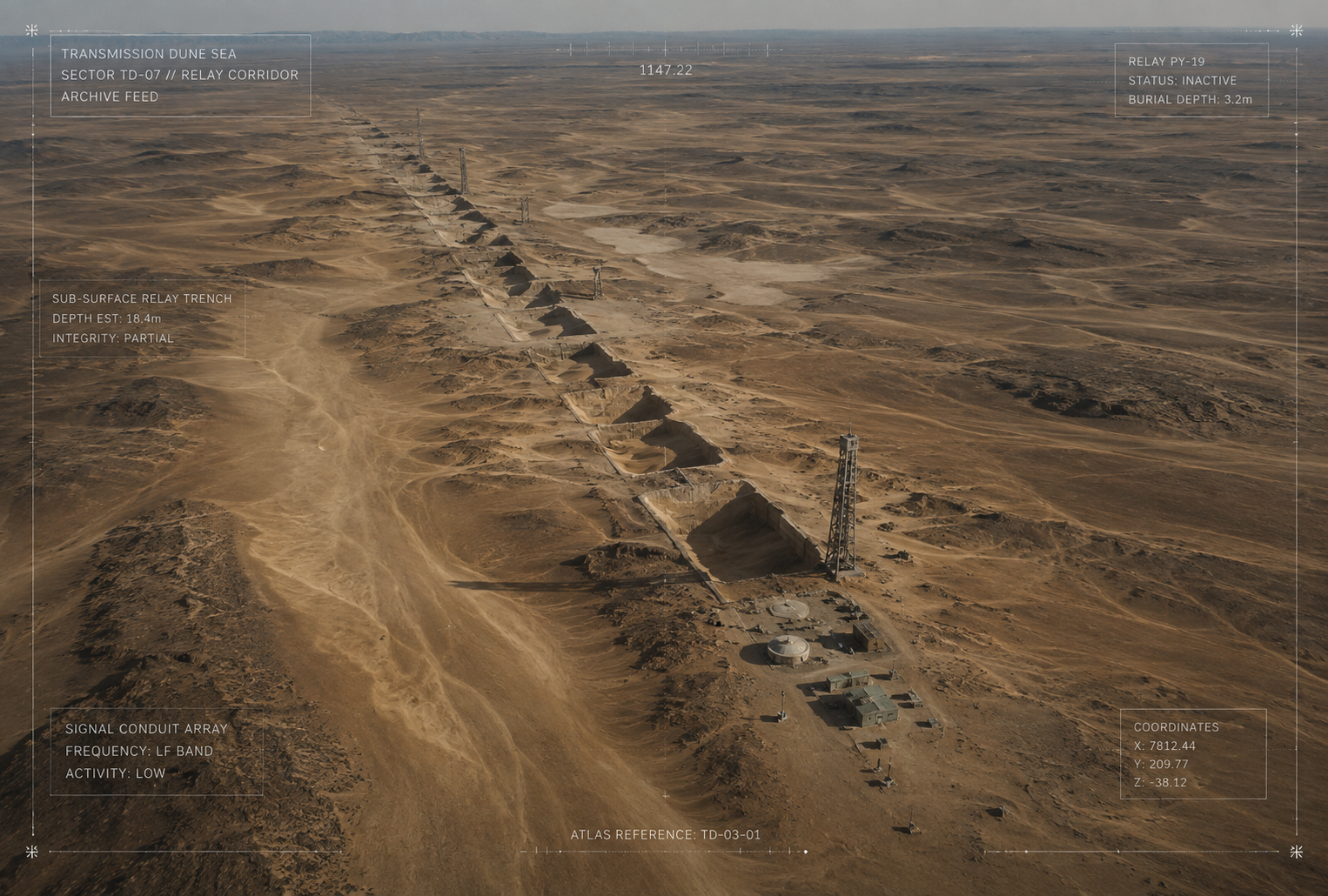
TDS-TOP-0001
TOPOLOGY RECORD
Sub-surface transmission continuity remained detectable
beneath dune formations across surveyed relay sectors.
Environmental burial did not interrupt long-range signal
propagation between inactive transmission structures.
No verified transmission origin or terminal relay point has
been recovered.
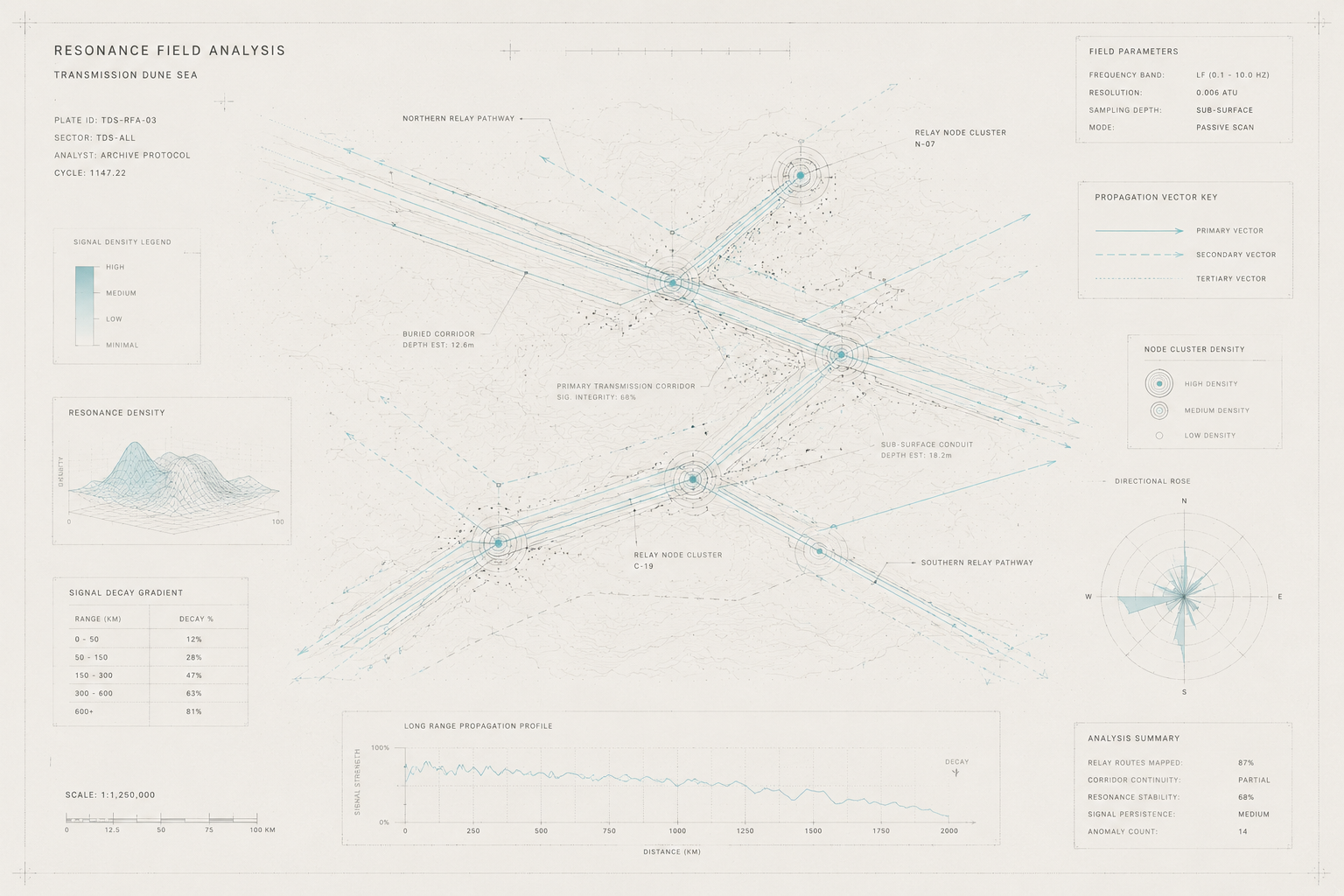
TDS-SIG-0096
SIGNAL RECORD
Directional signal resonance increases toward active relay convergence sectors.
Subsurface propagation pathways remain detectable beneath stable dune formations.
Long-range transmission stability remains unresolved across outer relay sectors.

TDS-SIG-0011
SIGNAL CONTINUITY RECORD
Synchronised transmission pulses remain intermittently active across separated relay sectors during low-atmospheric cycles.
Observers report directional instability and temporary navigational disagreement during active propagation events.
Sub-surface signal activity persists following visible transmission decay.
ASSOCIATED ENTITIES
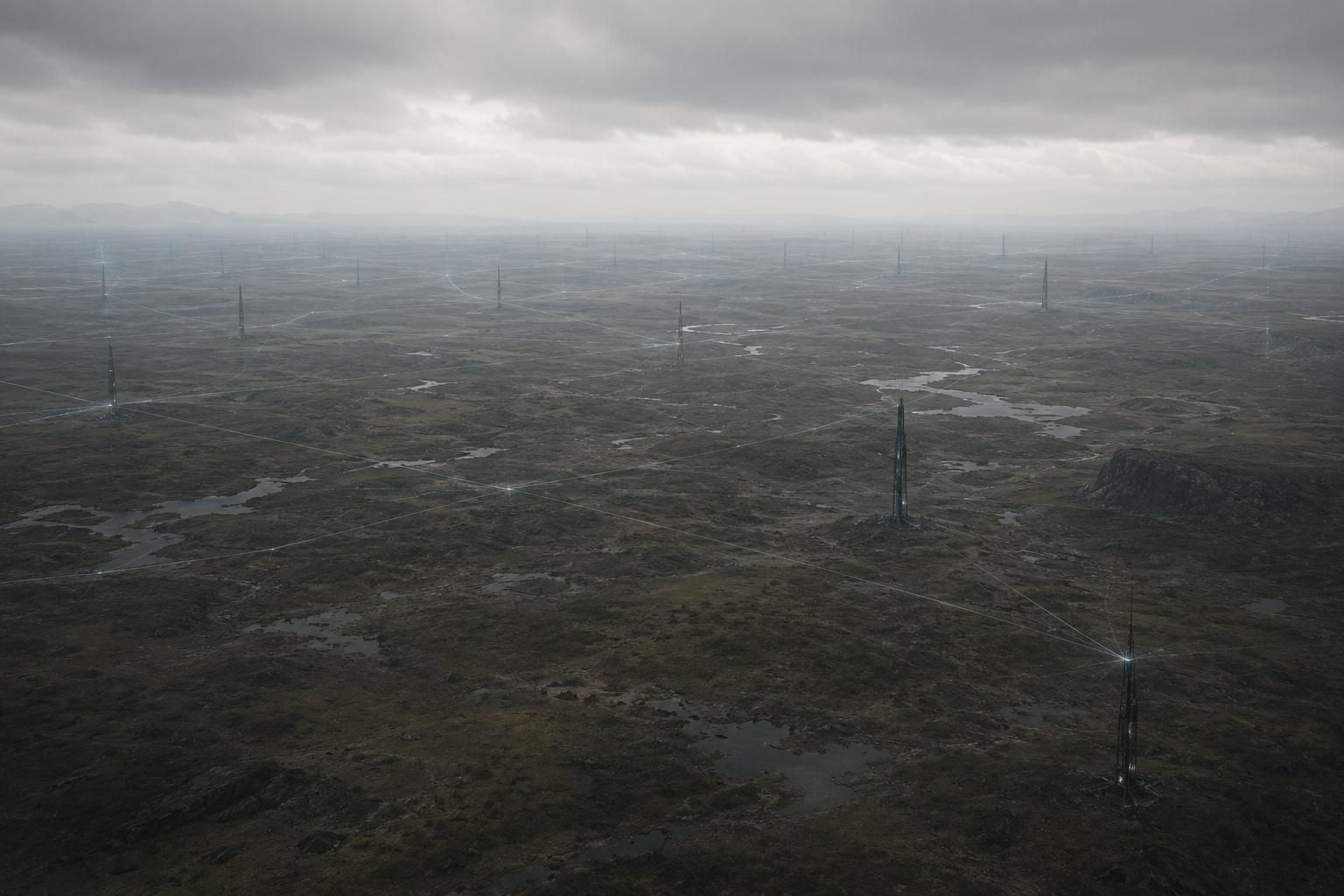
THE RELAY
Primary long-range transmission intelligence is associated with buried relay corridor synchronisation networks beneath the dune fields.

AEGIS LATTICE
Stabilisation-class entity intermittently observed near active relay convergence sectors and exposed signal fractures.

ARCHIVIST DRONES
Autonomous recovery and survey constructs are routinely detected along inactive relay trench systems during low-atmospheric transmission cycles.
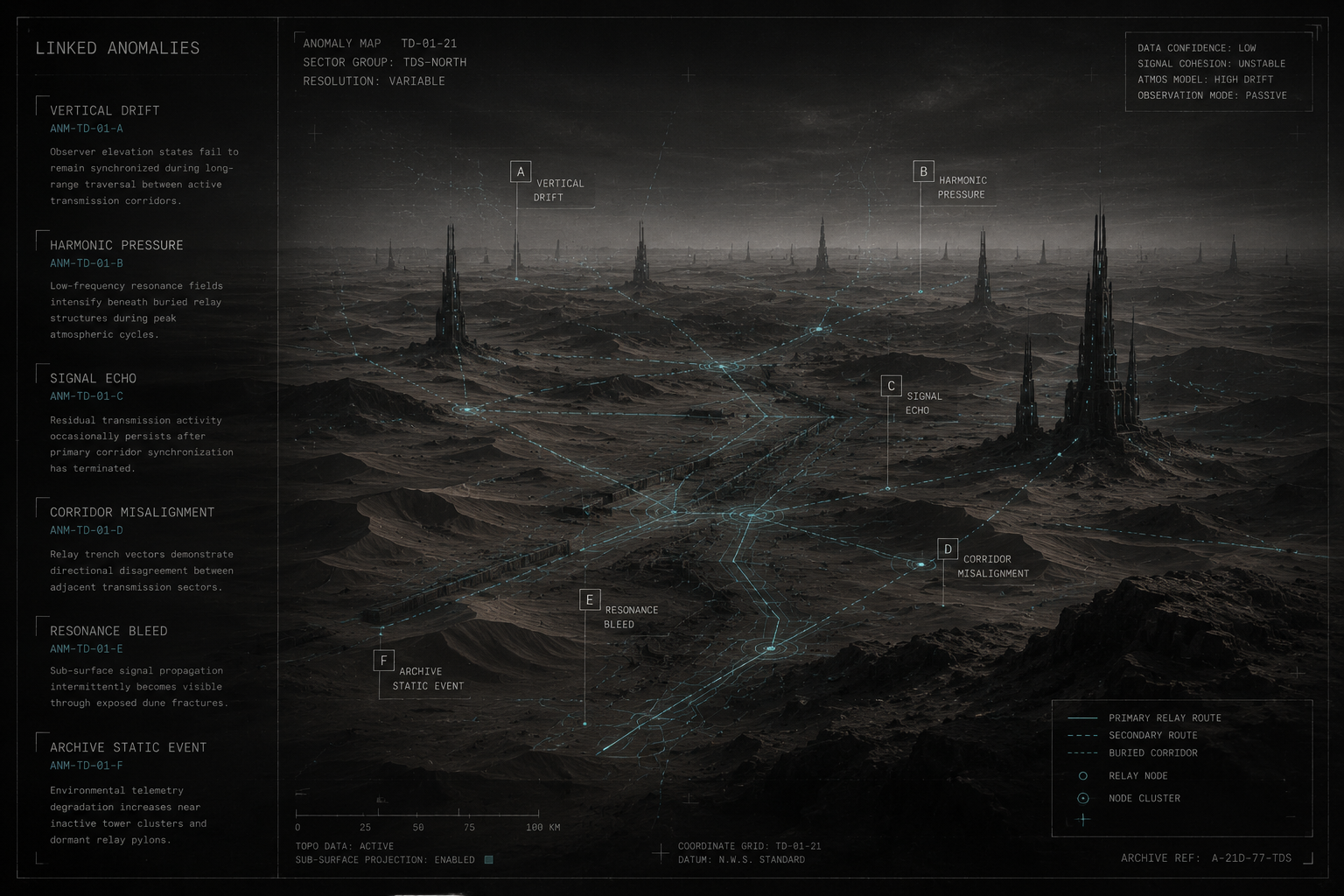
ANOMALY RECORDS
TDS-ANM-0001
SIGNAL REFRACTION
Transmission paths altered direction across successive survey cycles without corresponding environmental change.
TDS-ANM-0002
DUNE MIGRATION
Aeolian transport displaced established relay markers while maintaining uninterrupted communication pathways.
TDS-ANM-0003
CARRIER ECHO
Repeated transmission packets were received after verified source termination.
Origin remained unconfirmed.
TDS-ANM-0004
HORIZON RELAY
Long-range communication continued beyond the verified survey boundary without detectable infrastructure.
ARCHIVE RECORDS
TDS-SRV-0020
The relay corridor continued beyond the visible dune horizon after visual termination.
TDS-SIG-0176
Sub-surface signal activity increased during low-light atmospheric cycles.
TDS-OBS-0055
No complete transmission corridor has been traversed without directional disagreement.
TDS-SIG-0177
Synchronised tower illumination was observed beyond measurable distance limits.
TDS-OBS-0050
Buried relay structures remained partially active beneath inactive dune sectors.
DOCUMENT TYPES
OBS — Observation Record
SRV — Survey Record
RCV — Recovery Archive
ENT — Entity Encounter
ANM — Anomaly Record
SIG — Signal Record
ENVIRONMENTAL EVENTS
EVENT REGISTRY
TDS-EVT-0001
FIRST RECORDED TRANSMISSION
CURRENT STATUS
Verified
PRIMARY RECORD
TDS-SRV-0020
SUMMARY
The earliest documented long-range relay activation was detected across western transmission sectors. The transmission origin remains unresolved.
TDS-EVT-0002
TELEMETRY COLLAPSE EVENT
CURRENT STATUS
Restricted
PRIMARY RECORD
TDS-OBS-0054
SUMMARY
Multiple atmospheric survey arrays terminated simultaneously during synchronised corridor activation. No environmental failure capable of producing the interruption has been identified.
TDS-EVT-0003
HARMONIC FIELD SURGE
CURRENT STATUS
Stable
PRIMARY RECORD
TDS-SIG-0176
SUMMARY
Sustained low-frequency resonance propagated beneath eastern dune sectors for approximately 7.2 hours, confirming large-scale subsurface signal continuity.
TDS-EVT-0004
OBSERVER DISORIENTATION EVENT
CURRENT STATUS
Stable
PRIMARY RECORD
TDS-OBS-0035
SUMMARY
Multiple traversal teams reported conflicting directional telemetry while navigating adjacent transmission corridors. No consistent navigation reference could be established.
TDS-EVT-0005
SUB-SURFACE SIGNAL EMERGENCE
CURRENT STATUS
Verified
PRIMARY RECORD
TDS-SIG-0187
SUMMARY
Buried transmission pathways became temporarily visible through exposed dune fractures during high-pressure atmospheric cycles, confirming active propagation beneath surface layers.
TDS-EVT-0006
RELAY SYNCHRONISATION EVENT
CURRENT STATUS
Verified
PRIMARY RECORD
TDS-SRV-0090
SUMMARY
Multiple distant relay towers emitted coordinated pulse activity despite unresolved physical separation. Synchronisation occurred across previously isolated transmission sectors.

STATUS
Verified
INDEX
TDS-0005
REG-0000
REGISTRY
CONNECTED REGIONS
REG-0002
DREAMWELL BASIN
────────────
REG-0003
NEON PINNACLES
────────────
REG-0013
BOUNDARY VERGE
────────────
REG-0010
OBSIDIAN MOUNTAINS
────────────
REG-0001
ECHO FAULTS
DESCENT / EXIT