REGIONAL INDEX
REG-0009
LATTICE EXPANSE
MEMORY PRESERVATION REGION
Preserved lattice structures remain partially synchronised across crystalline archive sectors. Residual continuity fields continue to preserve fragmented historical memory networks.
CLASSIFICATION
Memory Preservation Region
TOPOLOGY
Crystalline Archive Terrain / Monolithic Memory Arrays
SIGNAL CONDITION
Deep Harmonic Synchronisation / Residual Continuity Preservation
OBSERVER CONDITION
Extended observation may produce historical echo phenomena, continuity repetition, and residual memory reconstruction events.
ARCHIVE STATUS
Partial Recovery
KNOWN STRUCTURAL STATE
Partially Active / Incomplete Reconstruction

ENVIRONMENTAL DESCRIPTION
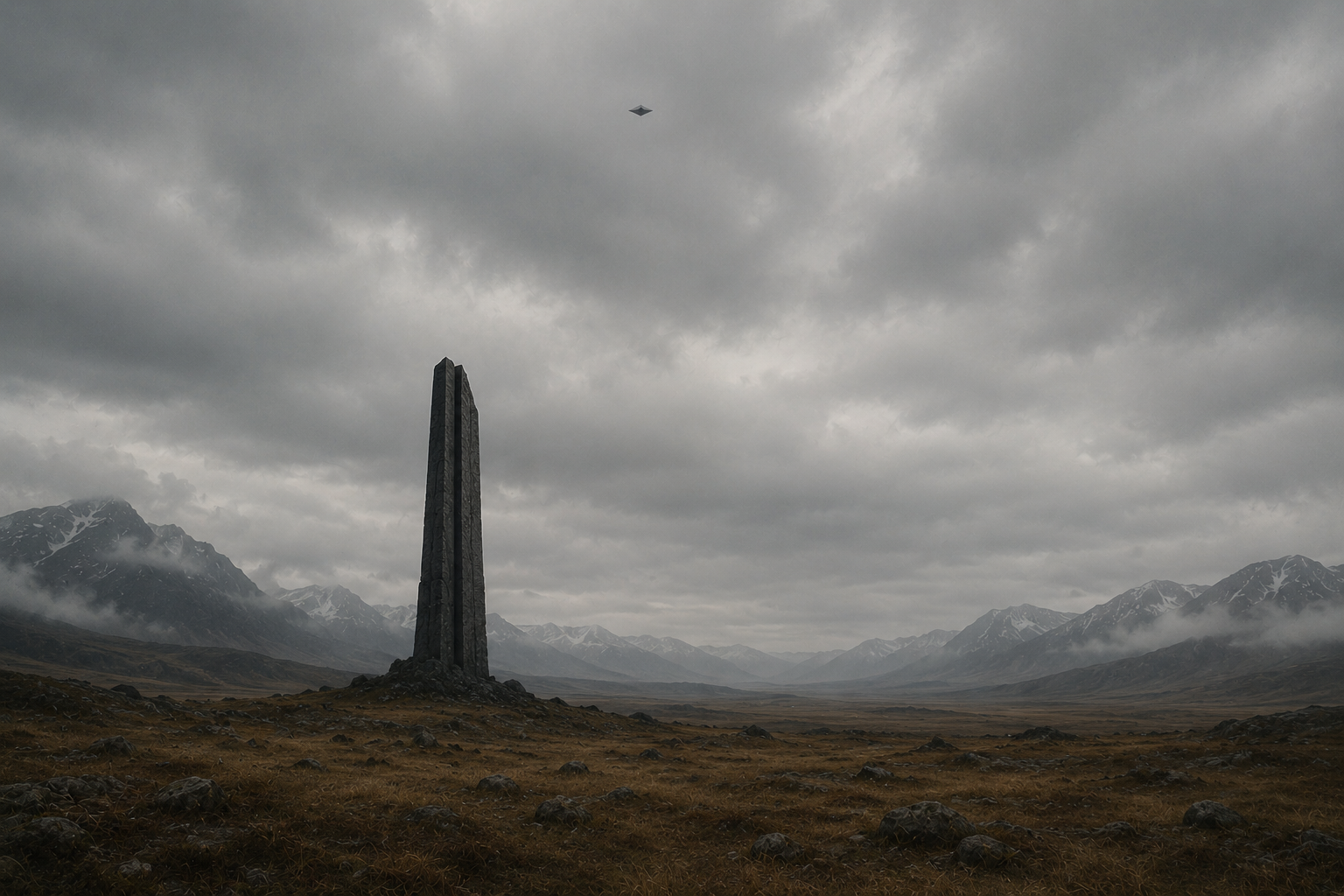
Traversal across Lattice Expanse reveals an immense crystalline archive substrate composed of vitrified memory formations, monolithic preservation structures, and interconnected lattice networks extending beyond observable distance.
Surface formations exhibit characteristics consistent with long-term archival preservation rather than conventional geological processes. Environmental analysis indicates the region functions as a distributed continuity framework responsible for maintaining historical memory integrity across adjacent sectors.
Embedded lattice channels emit low-frequency harmonic resonance associated with residual continuity preservation. Monumental archive structures remain partially synchronised through interconnected crystalline networks, forming a planetary-scale memory substrate rather than isolated architectural constructs.
Observers frequently report persistent environmental resonance, glass-like acoustic reflections, and intermittent historical echo phenomena originating beneath the visible surface during prolonged observation cycles.
No complete boundary of the preservation lattice has been documented.
TOPOLOGY / SIGNAL CONDITIONS
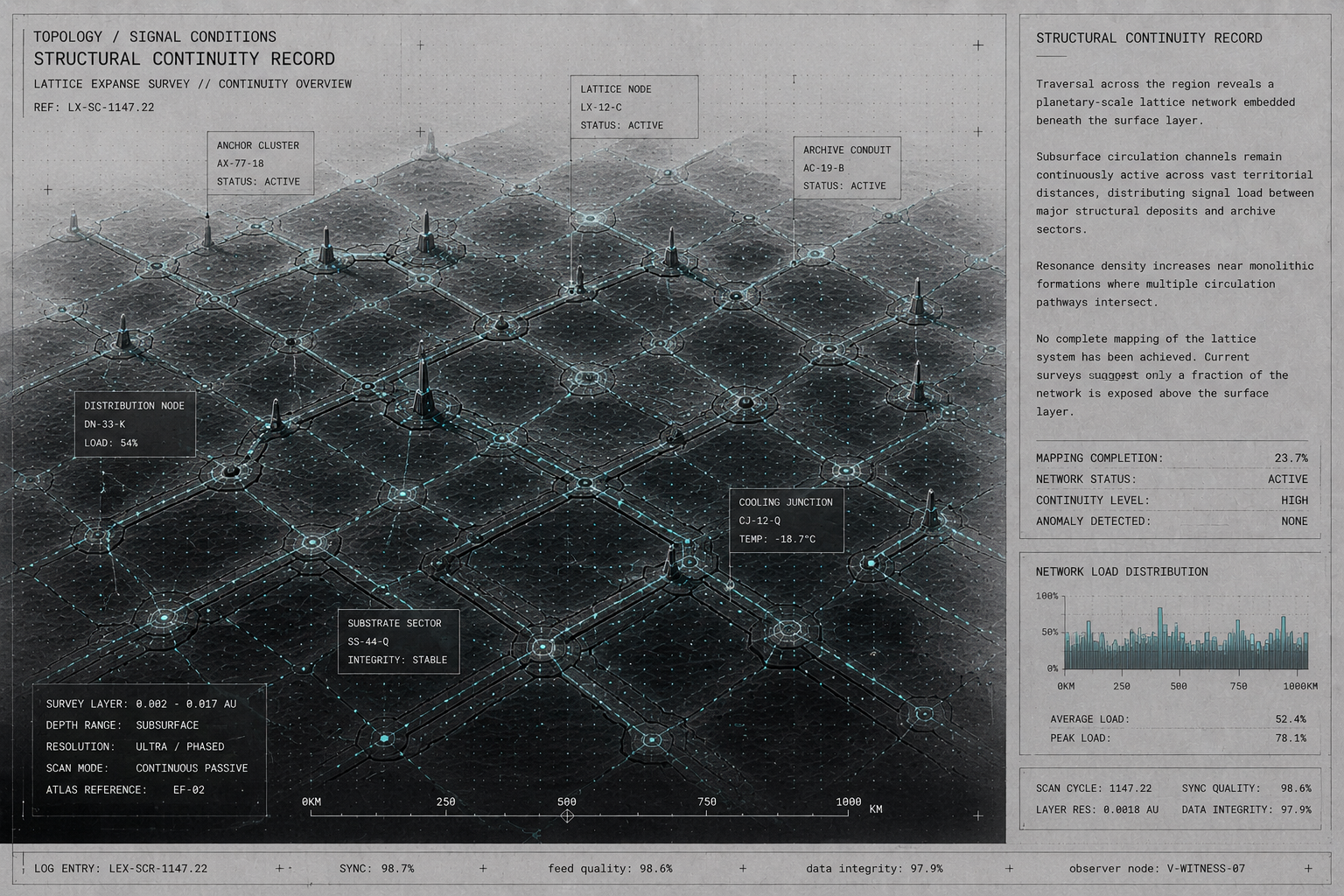
LE-TOP-0001
TOPOLOGY RECORD
Traversal across the region reveals a planetary-scale lattice network embedded beneath the surface layer.
Subsurface circulation channels remain continuously active across vast territorial distances, distributing signal load between major structural deposits and archive sectors.
Resonance density increases near monolithic formations where multiple circulation pathways intersect.
No complete mapping of the lattice system has been achieved. Current surveys suggest only a fraction of the network is exposed above the surface layer.
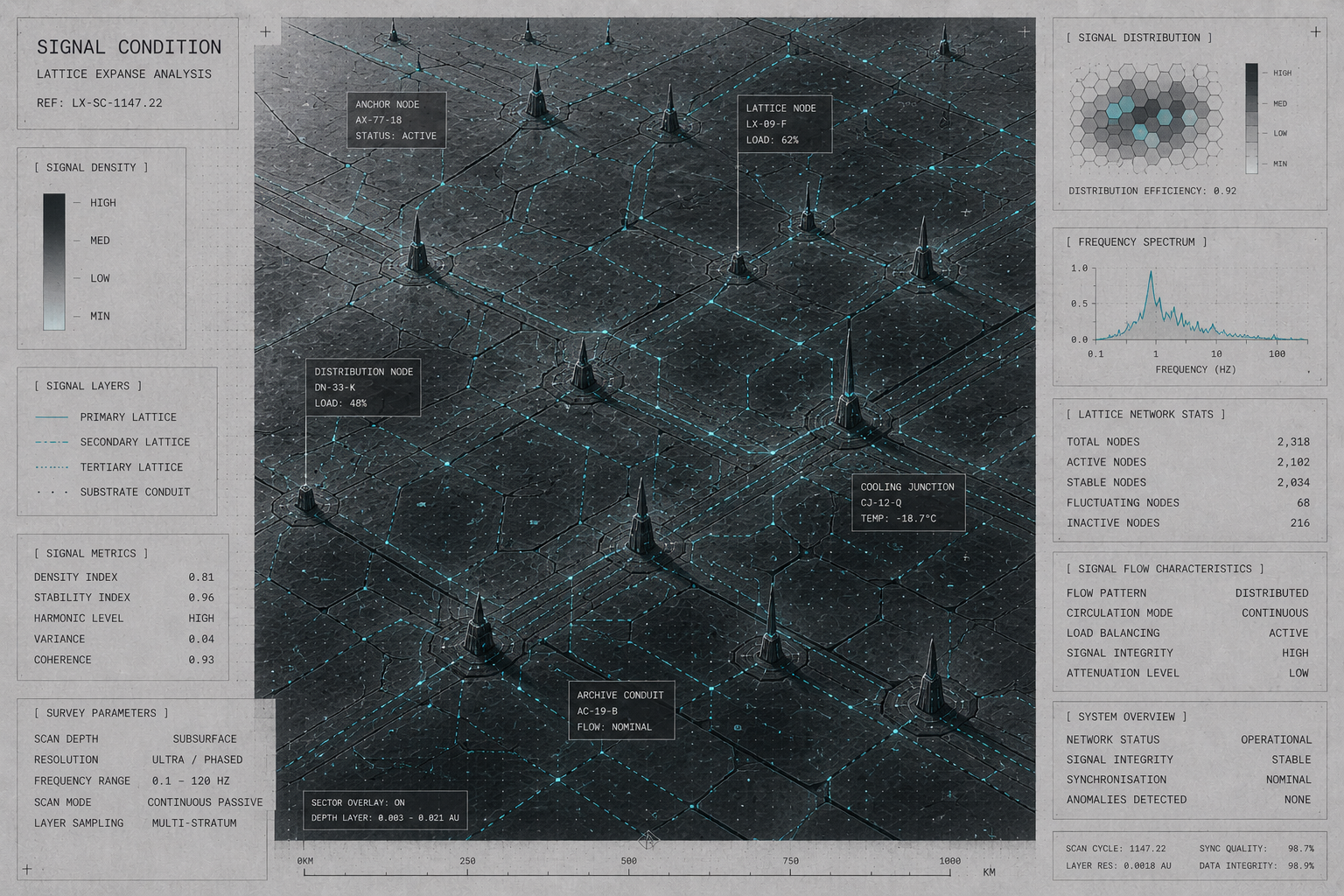
LE-SIG-0027
SIGNAL RECORD
Residual harmonic density increases toward major lattice intersections and monolithic preservation structures.
Low-frequency preservation resonance propagates continuously beneath the terrain through interconnected crystalline lattice networks.
Continuity integrity remains stable across the surveyed sectors, with only minor synchronisation variance recorded during elevated-resonance cycles.
The majority of preservation activity originates beneath currently accessible observation layers.
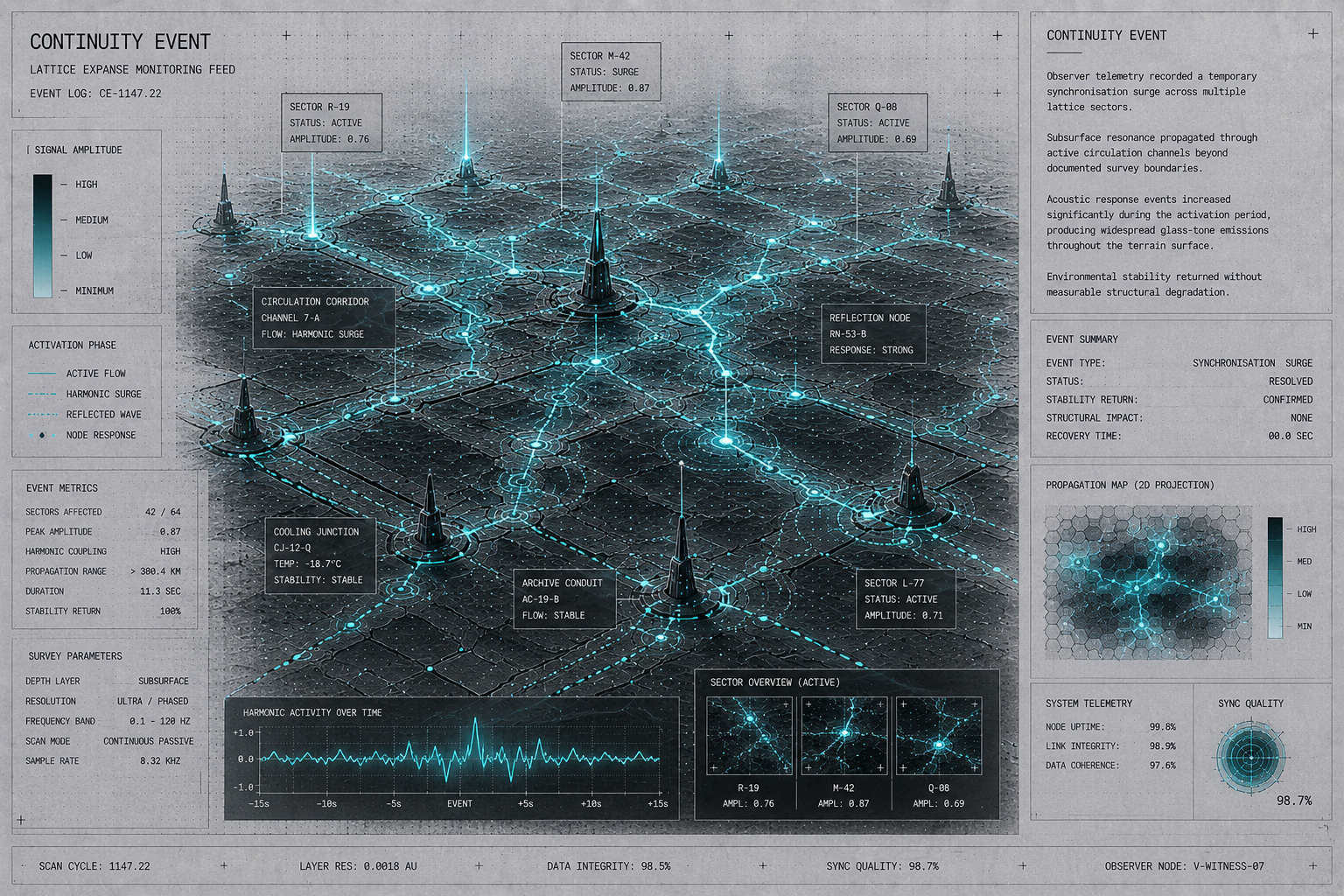
LE-OBS-0066
OBSERVATION RECORD
Observer telemetry recorded temporary continuity synchronisation across multiple lattice sectors.
Residual preservation fields propagated through interconnected archive structures beyond documented survey boundaries.
Low-frequency crystalline resonance produced sustained glass-like acoustic emissions during the synchronisation cycle.
Environmental continuity stabilised following the event, with no measurable degradation of preserved archive structures.
ASSOCIATED ENTITIES
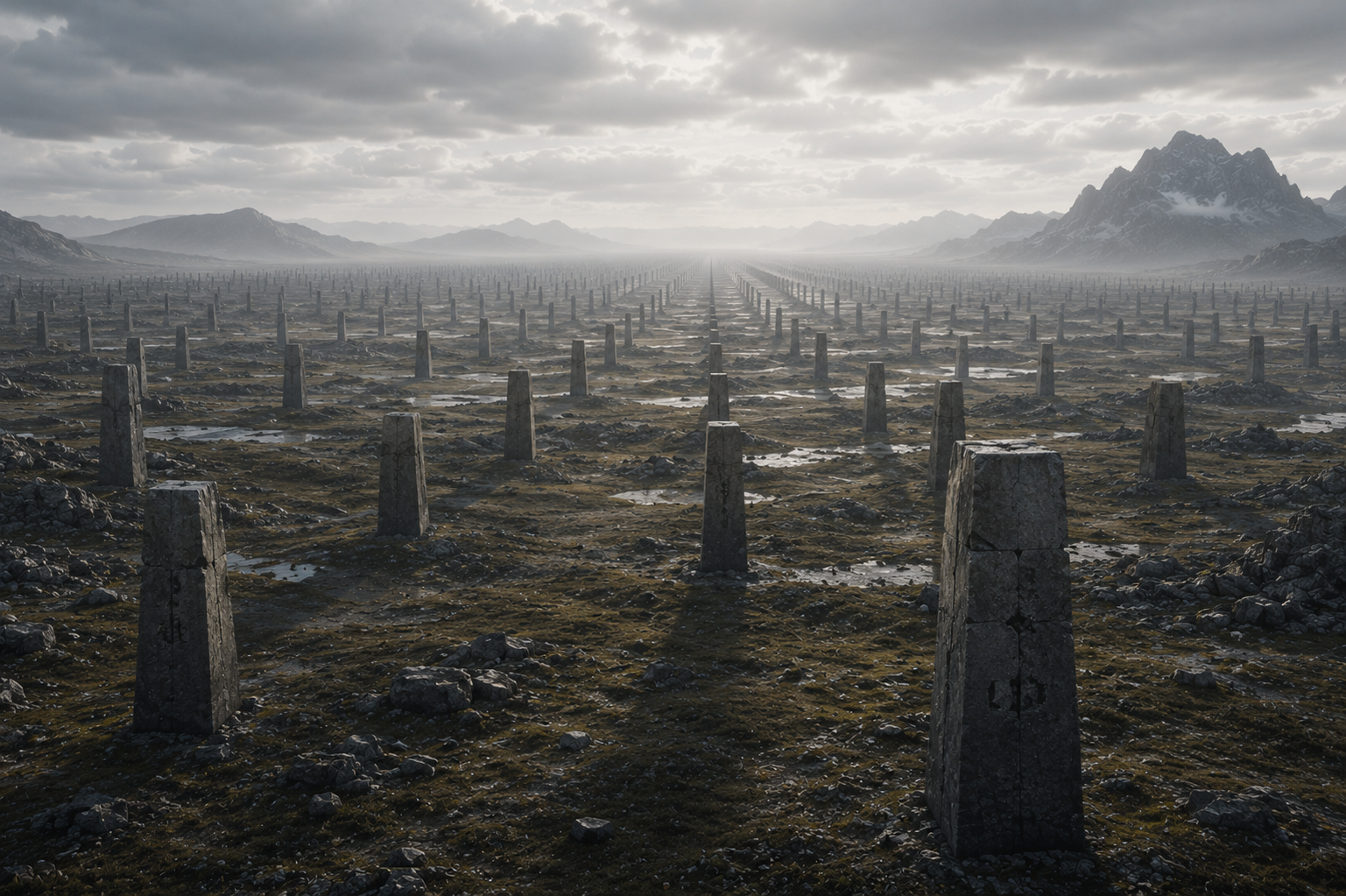
THE ARCHITECT
Residual reconstruction signatures have been intermittently recorded throughout upper lattice sectors.
Large-scale structural realignment events occasionally occur without measurable energy transfer or visible construction activity.
No confirmed Architect manifestation has been documented within the region.
ARCHIVIST
Autonomous survey units are routinely observed documenting lattice continuity, archive integrity, and structural preservation.
Recorded activity suggests ongoing verification of memory deposits rather than environmental intervention.
No hostile behaviour has been recorded.

KERNEL
Deep continuity structures are believed to exist beneath the primary lattice substrate.
Residual synchronisation patterns indicate an active preservation process operating beyond current observational limits.
Direct access to the central continuity layer remains unresolved.
ANOMALY RECORDS
LE-ANM-0001
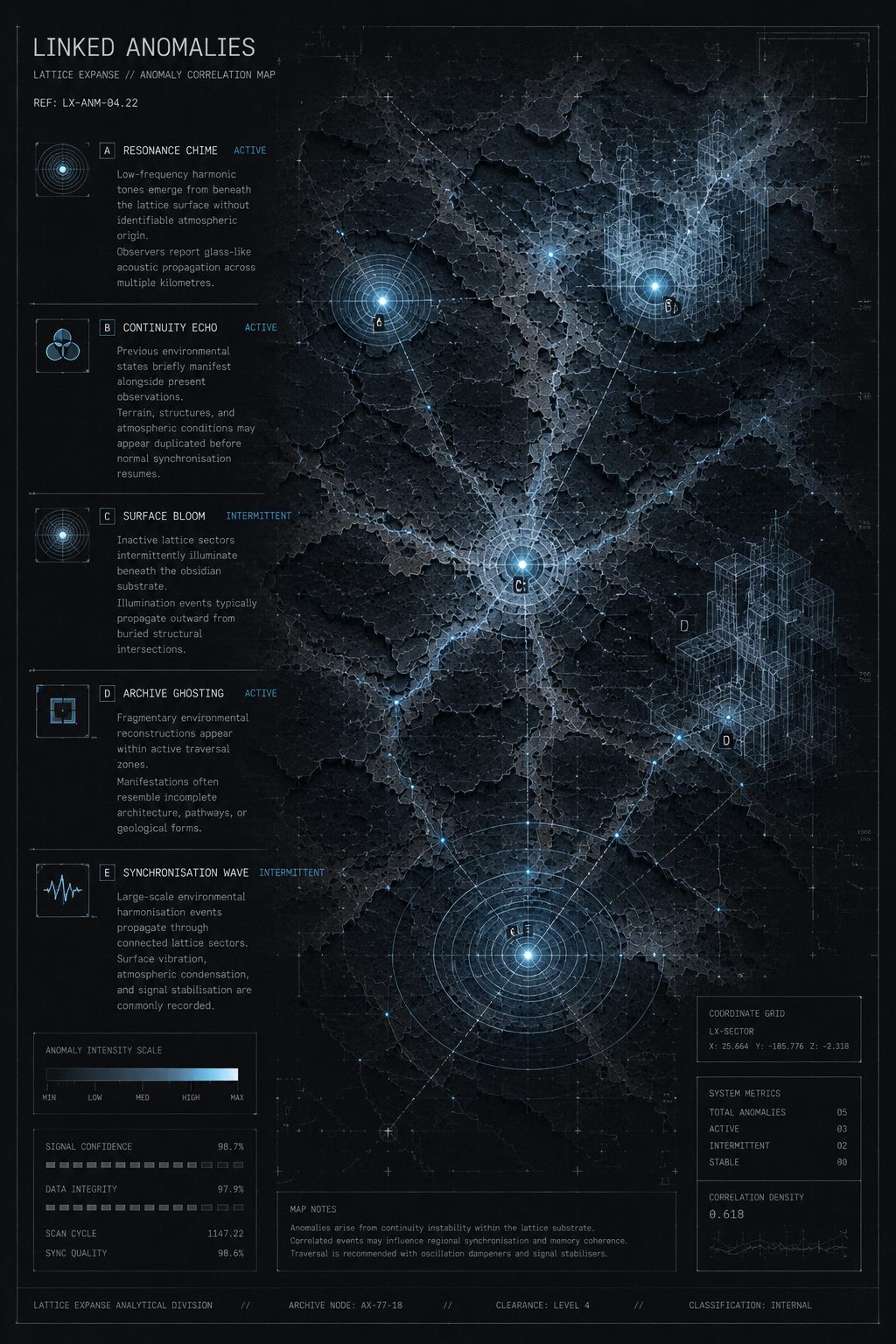
RESONANCE CHIME
Low-frequency harmonic resonance was recorded beneath preserved lattice sectors.
No atmospheric source has been verified.
LE-ANM-0002
CONTINUITY ECHO
Previously archived environmental states briefly overlapped active observations.
Normal synchronisation resumed without structural variation.
LE-ANM-0003
SURFACE BLOOM
Dormant lattice sectors emitted intermittent illumination beneath the crystalline substrate.
Propagation remained confined to preserved structural intersections.
LE-ANM-0004
ARCHIVE GHOSTING
Fragmentary historical structures appeared during active traversal cycles.
No corresponding Registry records have been recovered.
LE-ANM-0005
SYNCHRONISATION WAVE
Regional continuity harmonisation propagated across connected lattice sectors.
Environmental synchronisation stabilised following wave completion.
ARCHIVE RECORDS
LE-OBS-0004
The surface responded before contact was made.
LE-SIG-0003
Acoustic resonance continued after environmental motion ceased.
LE-SRV-0002
Illumination propagated beneath the terrain beyond mapped sector boundaries.
DOCUMENT TYPES
OBS — Observation Record
SRV — Survey Record
RCV — Recovery Archive
ENT — Entity Encounter
ANM — Anomaly Record
SIG — Signal Record
ENVIRONMENTAL EVENTS
EVENT REGISTRY
LE-EVT-0001
FIRST RESONANCE CHIME
CURRENT STATUS
Restricted
ASSOCIATED RECORD
LE-ER-0002
SUMMARY
The earliest documented harmonic propagation event originated beneath inactive lattice sectors. Acoustic transmission exceeded mapped regional boundaries without measurable atmospheric excitation.
LE-EVT-0003
CONTINUITY BLOOM
CURRENT STATUS
Stable
ASSOCIATED RECORD
LE-ER-0004
SUMMARY
Multiple inactive lattice sectors entered temporary synchronisation simultaneously. Environmental coherence increased for approximately seventeen minutes before returning to baseline.
LE-EVT-0005
SYNCHRONISATION WAVE
CURRENT STATUS
Stable
ASSOCIATED RECORD
LE-ER-0006
SUMMARY
A large-scale harmonic synchronisation wave propagated across connected lattice sectors. Signal stability temporarily increased across multiple archive junctions before normal operational variance resumed.
LE-EVT-0002
SUBSTRATE ILLUMINATION EVENT
CURRENT STATUS
Stable
ASSOCIATED RECORD
LE-ER-0003
SUMMARY
Large-scale blue luminescence propagated through dormant lattice formations. No initiating source or transmission origin was identified.
LE-EVT-0004
ARCHIVE RECONSTRUCTION EVENT
CURRENT STATUS
Restricted
ASSOCIATED RECORD
LE-ER-0005
SUMMARY
Fragmentary environmental reconstructions appeared throughout disconnected lattice sectors. Incomplete architectural forms, terrain fragments, and archive structures persisted briefly before dissolving.

STATUS
Verified
INDEX
EF-0009
REG-0000
REGISTRY
CONNECTED REGIONS
REG-0008
VEIN CONVERGENCE
────────
REG-0001
ECHO FAULTS
────────
REG-0013
BOUNDARY VERGE
────────
REG-0003
NEON PINNACLES
DESCENT / EXIT