Transmission Dune Sea
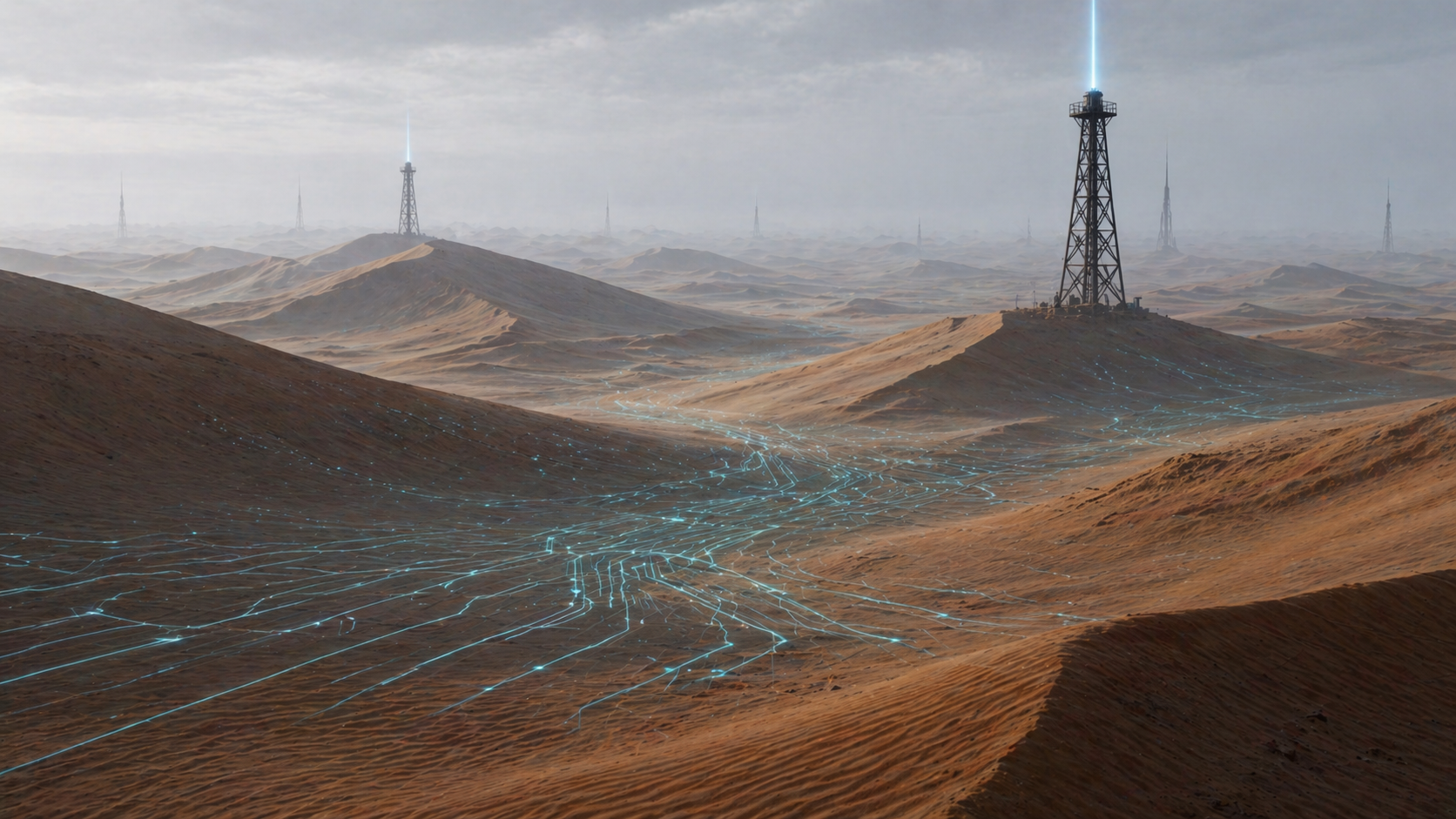
The Transmission Dune Sea is a vast, shifting expanse where structure gives way to dispersion; an environment defined not by absence, but by signal in decline. Rolling dunes stretch beyond visible limits, their surfaces etched with faint circuitry that emerges and vanishes with the movement of the terrain. Unlike the sharply defined channels of Vein Convergence, signal here no longer holds a singular path; it fractures, thins, and spreads laterally through the sand itself. The region exists in a state of active degradation, where coherence is not lost instantly, but slowly unraveled across distance and time. Light behaves differently here; subtle cyan traces pulse beneath the surface, while the air carries a soft atmospheric wash that reduces clarity and depth, as if the system itself is struggling to maintain resolution.
Scattered across the dunes are relay towers, skeletal structures rising at irregular intervals, each emitting a narrow vertical beam into the sky. These towers do not dominate the landscape; instead, they feel like remnants of an earlier, more stable system still functioning, but no longer sufficient. Their purpose appears to be corrective rather than generative: they intercept a fragmented signal, amplify what remains, and attempt to re-route it before it dissipates entirely. Yet their influence is localised. Beyond their reach, circuitry fades into faint, non-luminous impressions, traces that suggest a signal once passed through, but no longer does. The deeper one moves into the region, the less reliable these structures become, until they appear only as distant silhouettes through the haze.
The Transmission Dune Sea contains multiple operational zones, each representing a different stage of signal decay. In the upper band, often referred to as the Active Transmission Zone, circuitry remains visible and responsive, and signal pathways can still be followed, albeit imperfectly. Further inward lies the Attenuation Field, where the signal weakens significantly, shifting from luminous channels to barely perceptible etchings beneath the surface. Navigation becomes uncertain here, as pathways no longer maintain consistent direction or intensity. At the southern threshold, the terrain transitions toward the boundary of the Unmapped Sea—an area where signal coherence approaches zero, and the system’s ability to represent itself begins to fail.
Events within the Transmission Dune Sea are subtle but persistent. Signal flicker, partial rerouting, and transient alignments occur without warning, often creating the illusion of structure where none truly exists. There are no confirmed permanent entities native to the region; however, the environment itself behaves with a kind of systemic agency, guiding, dispersing, and occasionally resisting traversal. Observers report a gradual loss of orientation, not through obstruction, but through the erosion of reliable reference points. This is not a hostile region, nor is it passive; it is transitional, a place where the system delays collapse, allowing the signal to fade rather than end.