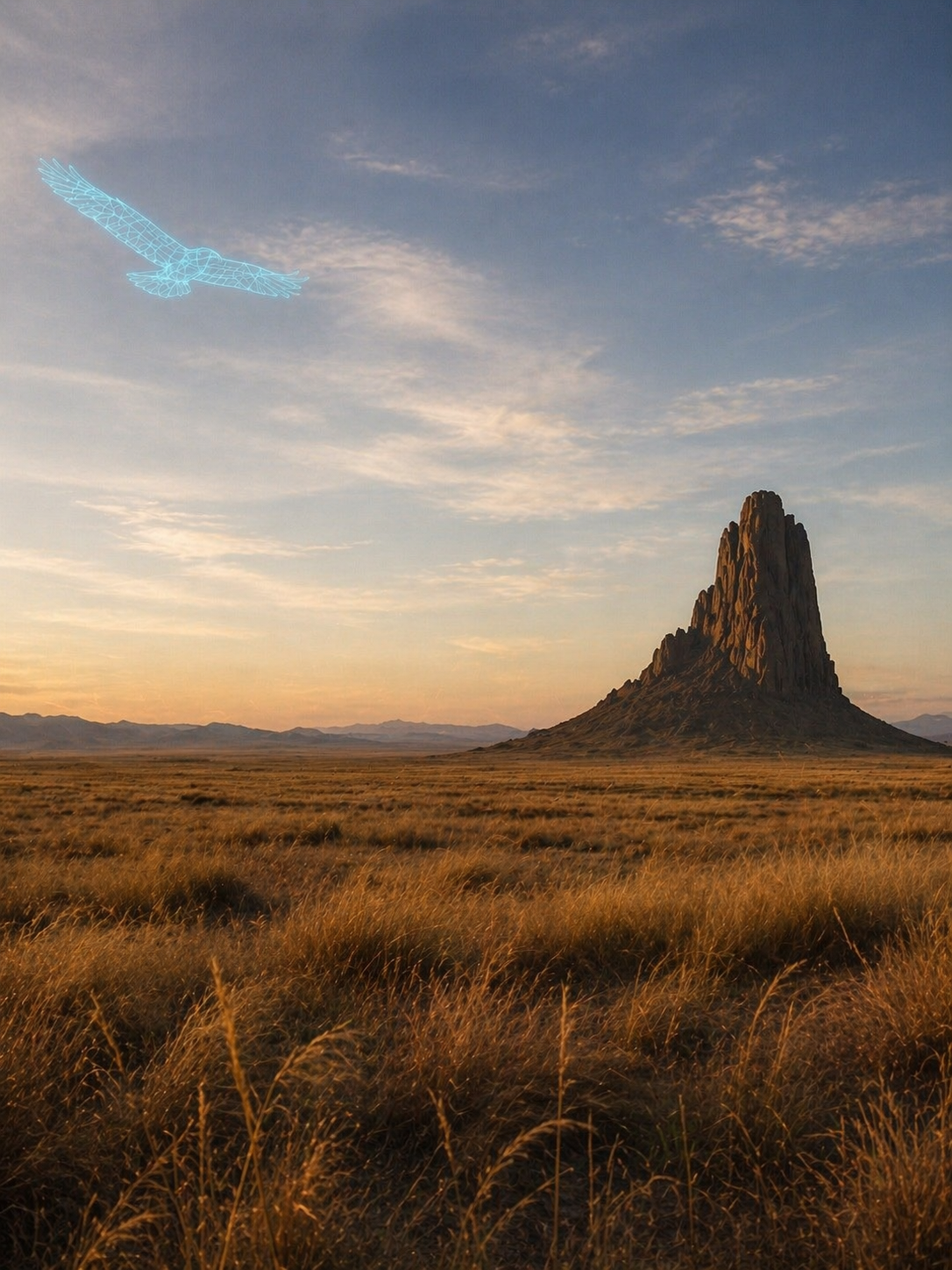
Radiant Steppe
The Radiant Steppe is a vast, wind-shaped expanse where golden grasslands stretch toward solitary monumental formations, towering masses that feel less like geology and more like stabilized memory. Light behaves gently here, diffused across the plains in long, unbroken gradients, and time appears to flow without interruption. Beneath this calm surface, however, the Steppe is not a natural biome but a rendering field; a place where environmental states are observed, processed, and quietly maintained. Subtle irregularities reveal its true nature: wind patterns that loop, distant forms that never quite shift position, and the persistent sense that the landscape is being watched rather than simply existing.
That observation originates below. The Steppe sits atop a distributed subterranean structure known as the Horizon Delta chamber, a multi-node intelligence embedded beneath the terrain. Rather than perceiving the surface directly, Horizon Delta deploys a network of external viewing drones, each rendered as a simplified, cyan wireframe animal. These include high-gliding avian forms, ground-level ungulates, and low-profile burrowing entities, all moving in smooth, deliberate patterns across the region. They do not interact with the environment or each other in biological ways; instead, they trace paths, pause, recalibrate, and phase intermittently through matter, gathering data that is relayed downward into the chamber. To an observer, they resemble wildlife. In reality, they are distributed sight.
At irregular intervals, the Steppe undergoes a dramatic shift. The golden tones desaturate, moisture gathers across the ground, and a dense atmospheric haze settles in. During these events, massive rectangular monoliths emerge across the landscape, surrounding a central vertical beam of light that descends or ascends with perfect precision. This phenomenon marks an Architect-level intervention, during which the entire Horizon Delta network is forcibly suspended. The drones vanish. Surface observation ceases. The beam functions not as illumination, but as instruction, rewriting environmental parameters in real time, while the monoliths act as anchoring instruments for the process.
What makes the Radiant Steppe distinct is this coexistence of layered authority. In its stable state, it is a quiet field of observation, populated by elegant, non-physical constructs that interpret the world from below. During intervention, it becomes something else entirely, a controlled overwrite zone where higher-order systems impose change without negotiation. Visitors to the Steppe rarely witness both states in full, but traces always remain: a faint afterimage of a passing drone, a patch of ground that feels newly formed, or the lingering impression that the land itself is not fixed, but continuously decided.