REGIONAL INDEX
REG-0010
OBSIDIAN MOUNTAINS
PRIMARY RESONANCE FORMATION
Primary harmonic continuity remains stable. Structural resonance persists across surveyed formations.
CLASSIFICATION
Primary Resonance Formation
TOPOLOGY
Megascale Obsidian Formations / Crystalline Resonance Massifs
SIGNAL CONDITION
Persistent Low-Frequency Harmonic Resonance
OBSERVER CONDITION
Extended exposure may produce auditory resonance perception and spatial acoustic distortion.
ARCHIVE STATUS
Stable
KNOWN STRUCTURAL STATE
Partially Surveyed
ENVIRONMENTAL DESCRIPTION
The Obsidian Mountains comprise one of the oldest documented geological formations within the archive.
Megascale obsidian escarpments extend across elevated resonance plains, forming expansive volcanic glass structures, fractured ridgelines, and persistent low-atmosphere condensation fields.
Unlike neighbouring instability regions, large-scale structural continuity remains intact. Topological drift is minimal, and no active reconstruction events have been observed within surveyed sectors.
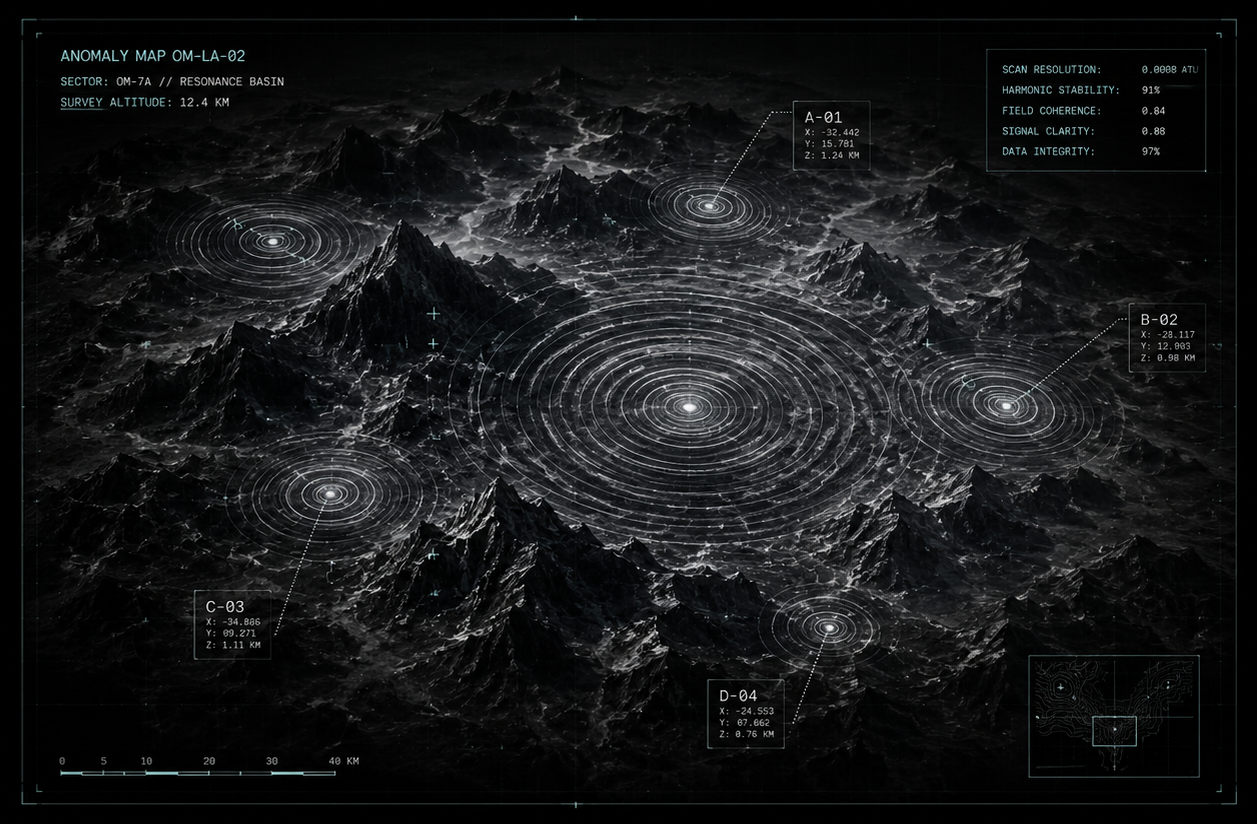
Persistent harmonic circulation continues beneath the mountain network. During periods of elevated atmospheric moisture, exposed formations emit low-frequency resonance tones that propagate across ridge systems and fracture valleys.
Long-range survey records indicate resonance density increases with elevation and structural mass. Acoustic anomalies remain the most consistently documented environmental condition.
Observers describe distant harmonic tones, glass-like acoustic responses, and low-frequency vibration without an identifiable atmospheric origin.
The region remains partially surveyed. Numerous elevated formations and inner mountain sectors have not yet been successfully traversed.
TOPOLOGY / SIGNAL CONDITIONS
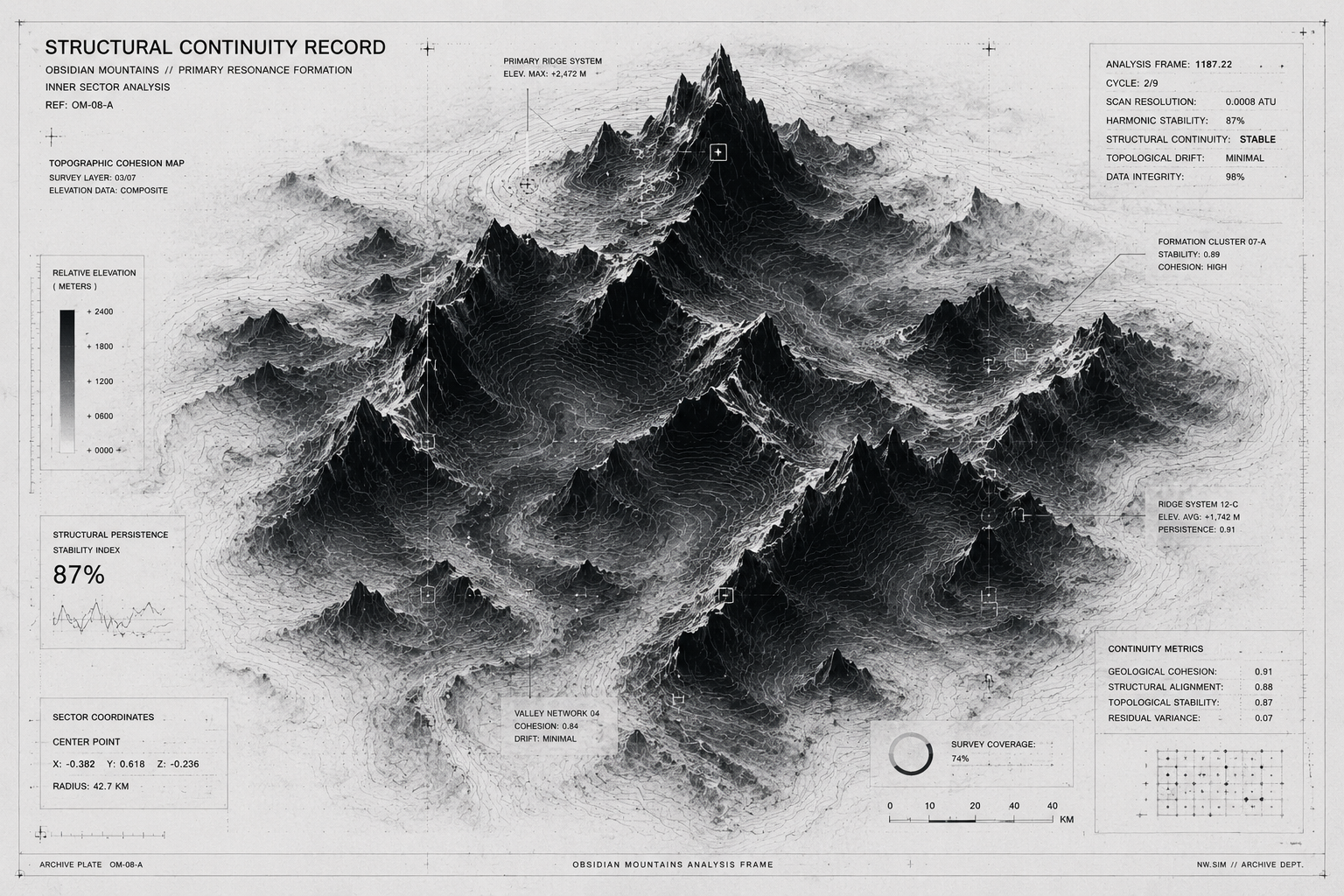
OM-TOP-0022
TOPOLOGY RECORD
Megastructure formations maintain consistent geological continuity across surveyed sectors.
Resonance density increases proportionally with elevation and structural mass.
No significant topological disagreement has been documented within surveyed formations.
Primary mountain systems remain among the most structurally stable regions currently catalogued.
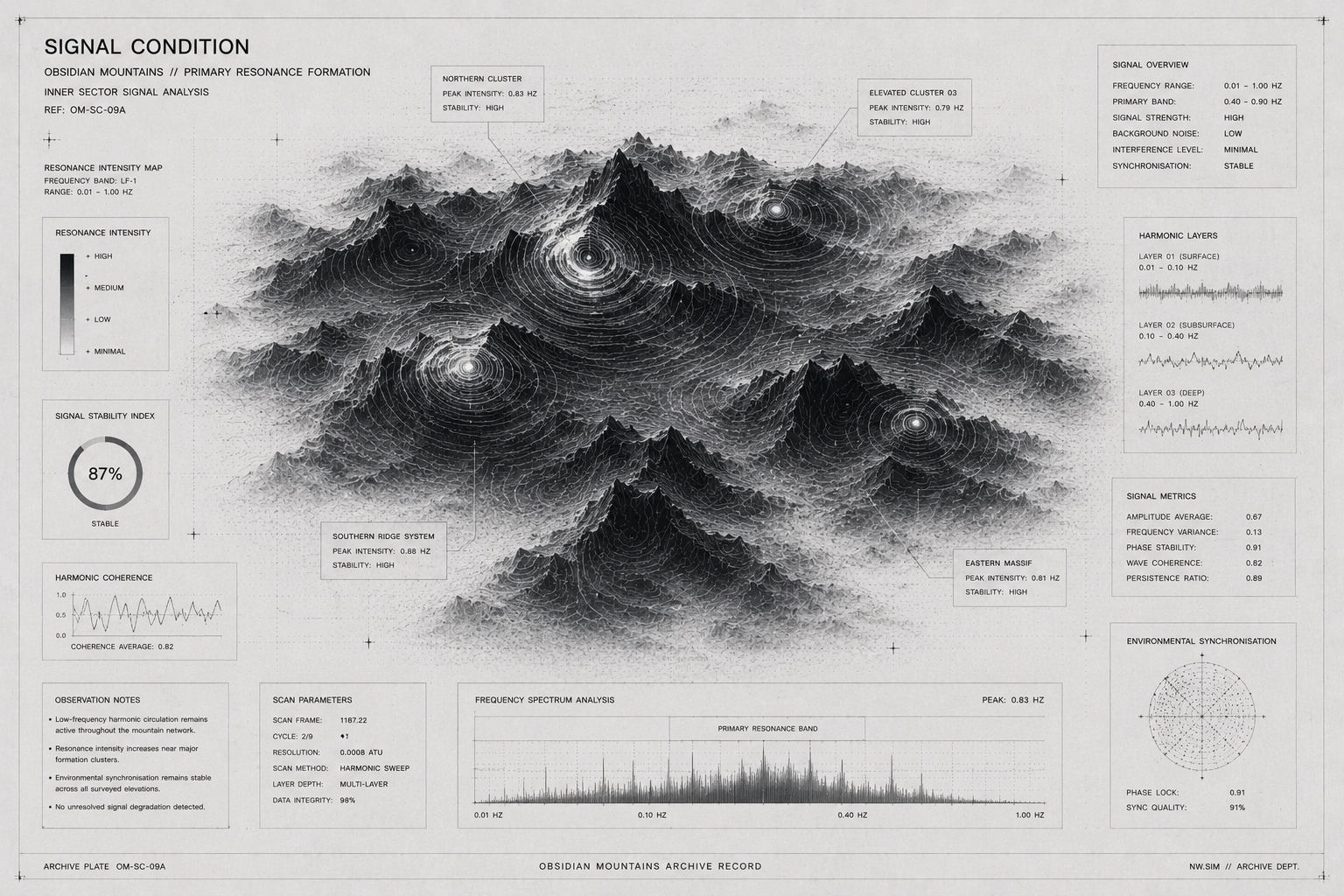
OM-SIG-0009
SIGNAL RECORD
Persistent low-frequency harmonic circulation remains active throughout surveyed mountain sectors.
Signal density increases near primary formation clusters.
Harmonic continuity remains stable across all surveyed elevations.
No unresolved signal degradation has been detected.
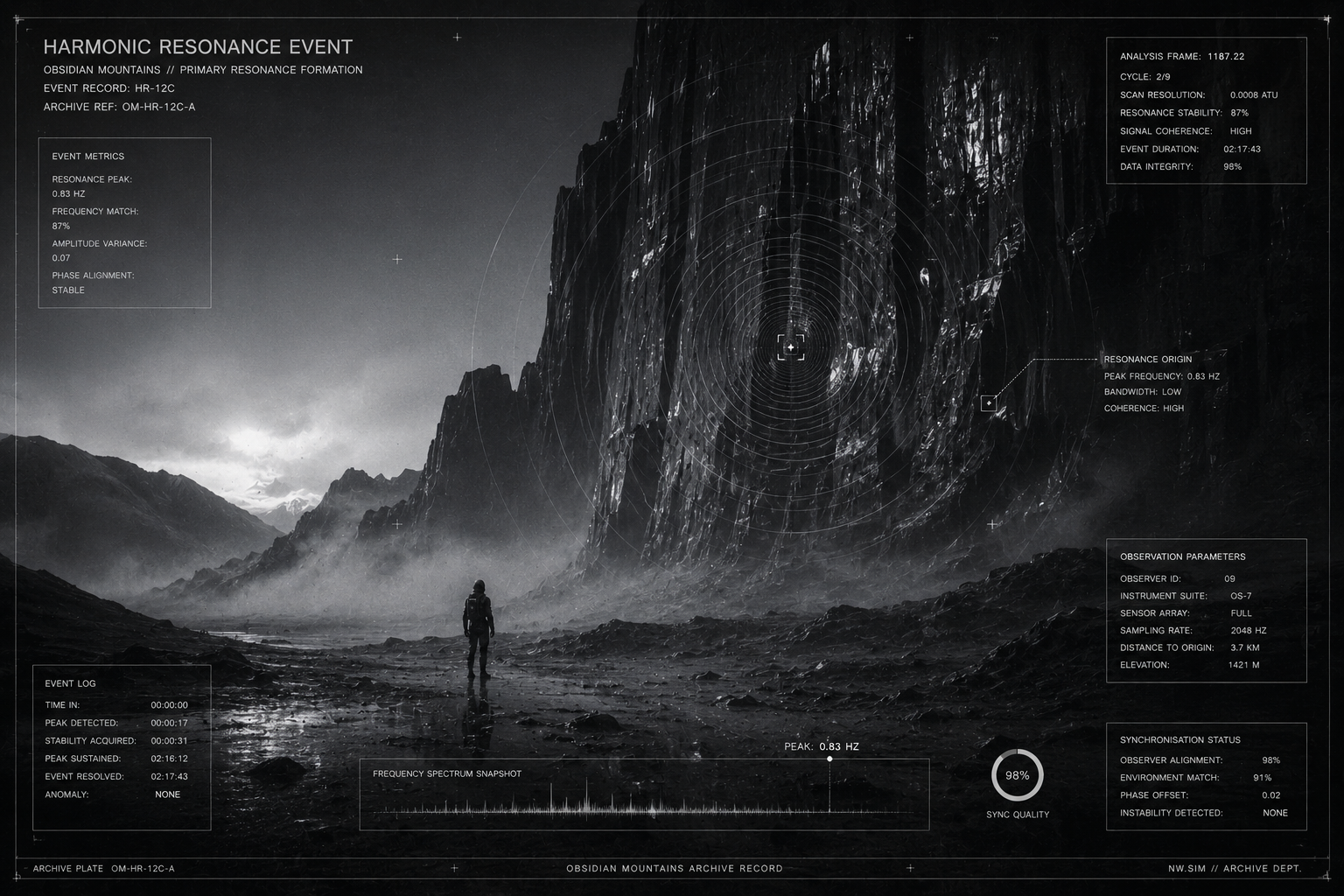
OM-OBS-0009
OBSERVATION RECORD
Multiple mountain formations entered synchronous harmonic resonance during a single observation cycle.
Low-frequency acoustic propagation was recorded across approximately 42 kilometres without measurable attenuation.
Observer instrumentation detected no structural instability, topological drift, or signal degradation throughout the recorded event.
ASSOCIATED ENTITIES

THE ARCHITECT
Primary reconstruction authority signatures have been intermittently detected throughout upper mountain sectors.
Architect manifestations remain brief and non-localised, appearing as large-scale illumination events rather than discrete physical entities.
No direct communication has been verified within surveyed regions.

ARCHIVIST
Long-range survey drones periodically traverse resonance corridors between major mountain formations.
Telemetry recovery indicates continued environmental monitoring despite the absence of nearby archive facilities.
Drone behaviour remains observational and non-interventionist.
ANOMALY RECORDS
OM-ANM-0001
RESONANCE ECHO
Residual harmonic signatures persisted after the primary resonance event concluded.
No originating resonance source could be verified.
OM-ANM-0002
FIELD PHASING
Atmospheric density synchronised with subsurface resonance cycles.
Phase transitions occurred without measurable structural displacement.
OM-ANM-0003
STANDING WAVE FORMATION
Large-scale harmonic nodes stabilised across multiple mountain formations.
Environmental vibration persisted following resonance convergence.
OM-ANM-0004
SIGNAL REFRACTION
Resonance propagation deviated around major obsidian formations.
Observer positional certainty decreased while traversing affected sectors.
ARCHIVE RECORDS
OM-SRV-0005
The sound arrived before the vibration. The vibration arrived before the source.
OM-OBS-0003
Multiple mountain sectors responded simultaneously despite separation beyond visual range
OM-RCV-0007
No movement was detected. The mountains continued speaking.
DOCUMENT TYPES
OBS — Observation Record
SRV — Survey Record
RCV — Recovery Archive
ENT — Entity Encounter
ANM — Anomaly Record
SIG — Signal Record
ENVIRONMENTAL EVENTS
EVENT REGISTRY
OM-EVT-0001
FIRST ARCHITECT MANIFESTATION
CURRENT STATUS
Restricted
ASSOCIATED RECORD
OM-ER-0002
SUMMARY
The earliest verified Architect illumination event was recorded within a stable mountain sector.
OM-EVT-0003
FIELD SYCHRONISATION EVENT
CURRENT STATUS
Stable
ASSOCIATED RECORD
OM-ER-0004
SUMMARY
Multiple resonance basins synchronised simultaneously across geographically separated mountain sectors.
OM-EVT-0002
GREAT RESONANCE SURVEY
CURRENT STATUS
Stable
ASSOCIATED RECORD
OM-ER-0003
SUMMARY
A prolonged harmonic survey established the first complete resonance model of the primary mountain formations.
OM-EVT-0004
BLACKGLASS EXPEDITION
CURRENT STATUS
Stable
ASSOCIATED RECORD
OM-ER-0005
SUMMARY
The first successful expedition traversed previously unmapped mountain sectors.

STATUS
Verified
INDEX
REG-0010
REG-0000
REGISTRY
CONNECTED REGIONS
REG-0009
LATTICE EXPANSE
────────
REG-0011
THE PALE SILENCE
────────
REG-0013
BOUNDARY VERGE
DESCENT / EXIT