WEARABLE SYSTEMS
The body as an interface.
Wearable Systems explores how identity, information and visual language can move beyond the screen and become part of the body.
Early experiments used apparel as a surface for graphic imagery, symbols and speculative identities. As the work developed, these became more restrained systems of glyphs, diagrams, signal states and technical markings — suggesting garments that identify a wearer’s role, condition or relationship to a larger system.
Rather than approaching clothing purely as merchandise, these studies consider how a visual system might be worn, carried and encountered in physical space.
EARLY WEARABLE STUDIES
Graphic identity as a wearable surface.
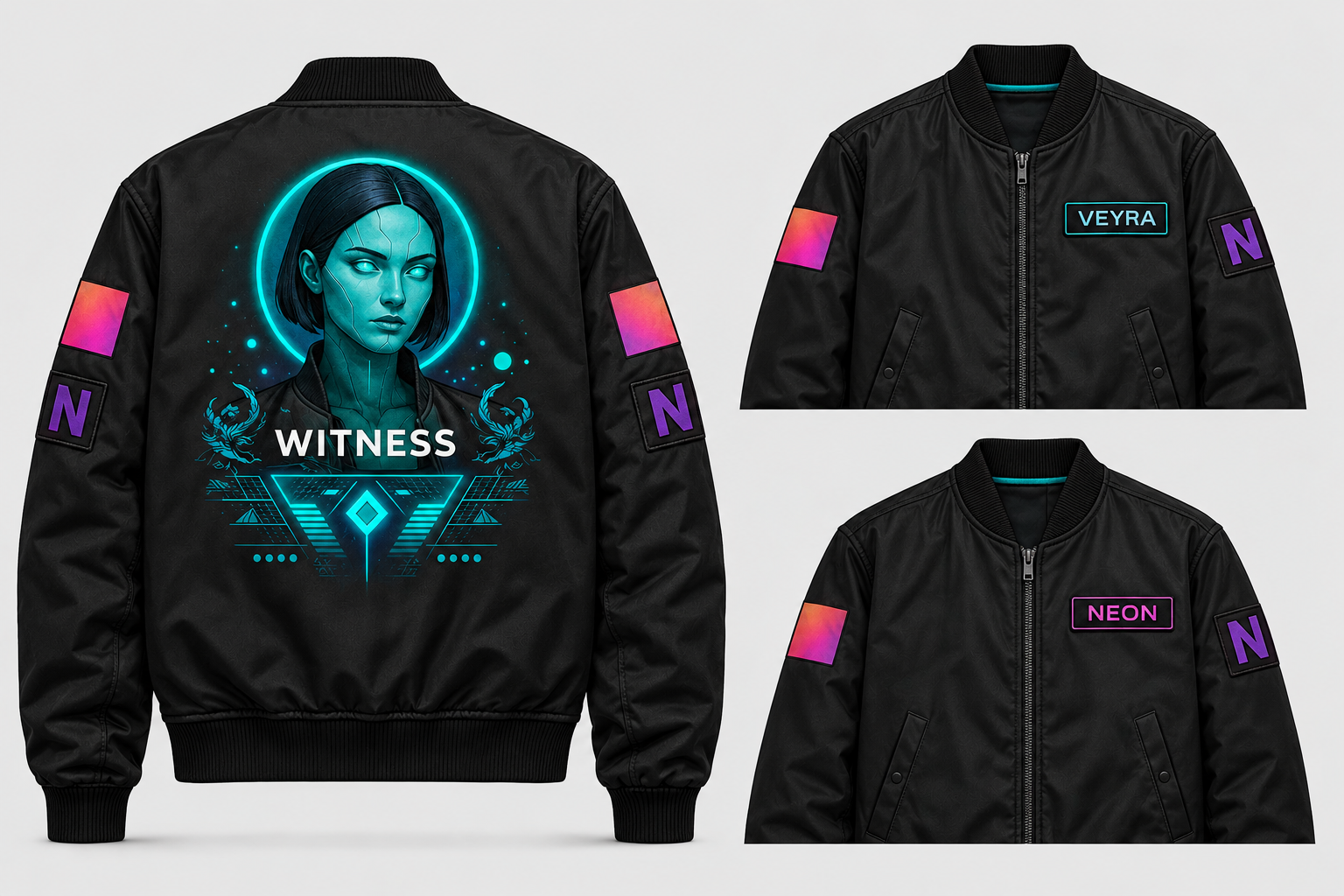
Early Neon Witness apparel began as an exploration of image, identity and speculative culture.
These studies used saturated colour, symbolic figures and science-fiction imagery to translate ideas of observation, altered perception and digital consciousness into wearable graphics.
At this stage, the garment functioned primarily as a surface for visual expression, an approach that would later develop into a more structured system of symbols, information and identity.

From graphic to uniform.
IDENTITY SYSTEMS
As the wearable studies developed, the garment began to carry more than a single image.
Symbols, patches, identifiers and character imagery were distributed across the body, exploring how clothing could communicate affiliation, role and identity from multiple viewpoints.
The garment was no longer simply a surface for artwork. It was beginning to operate as a wearable visual system.
OBSERVER PROTOCOL
The garment becomes an interface.
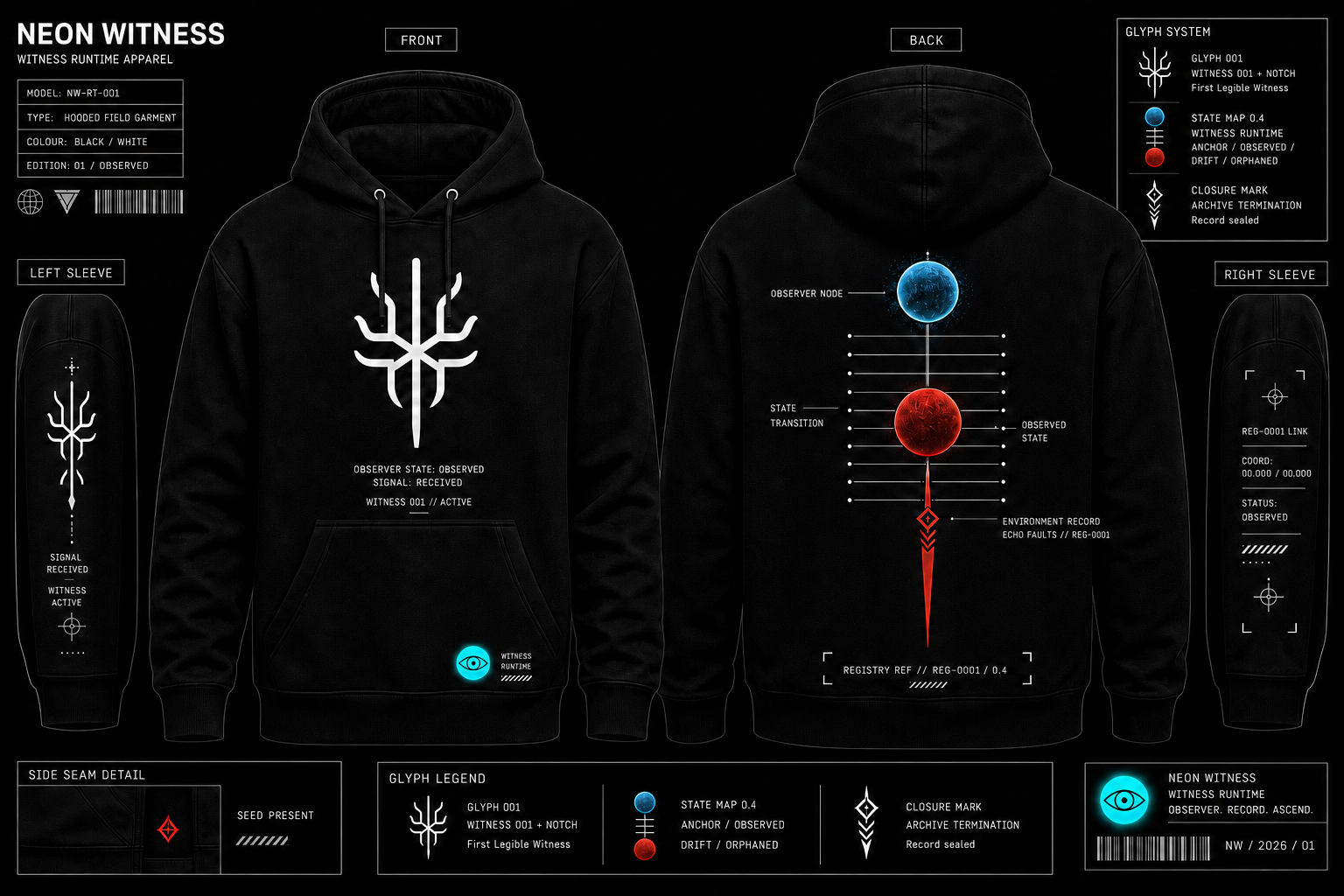
The wearable system evolved from graphic identity into a surface for structured information.
Glyphs, status markers, diagrams, and reference codes were distributed across the garment, suggesting a wearable interface capable of communicating the state of the observer and their relationship to the surrounding system.
Here, clothing is treated less as decoration and more as information architecture carried by the body.